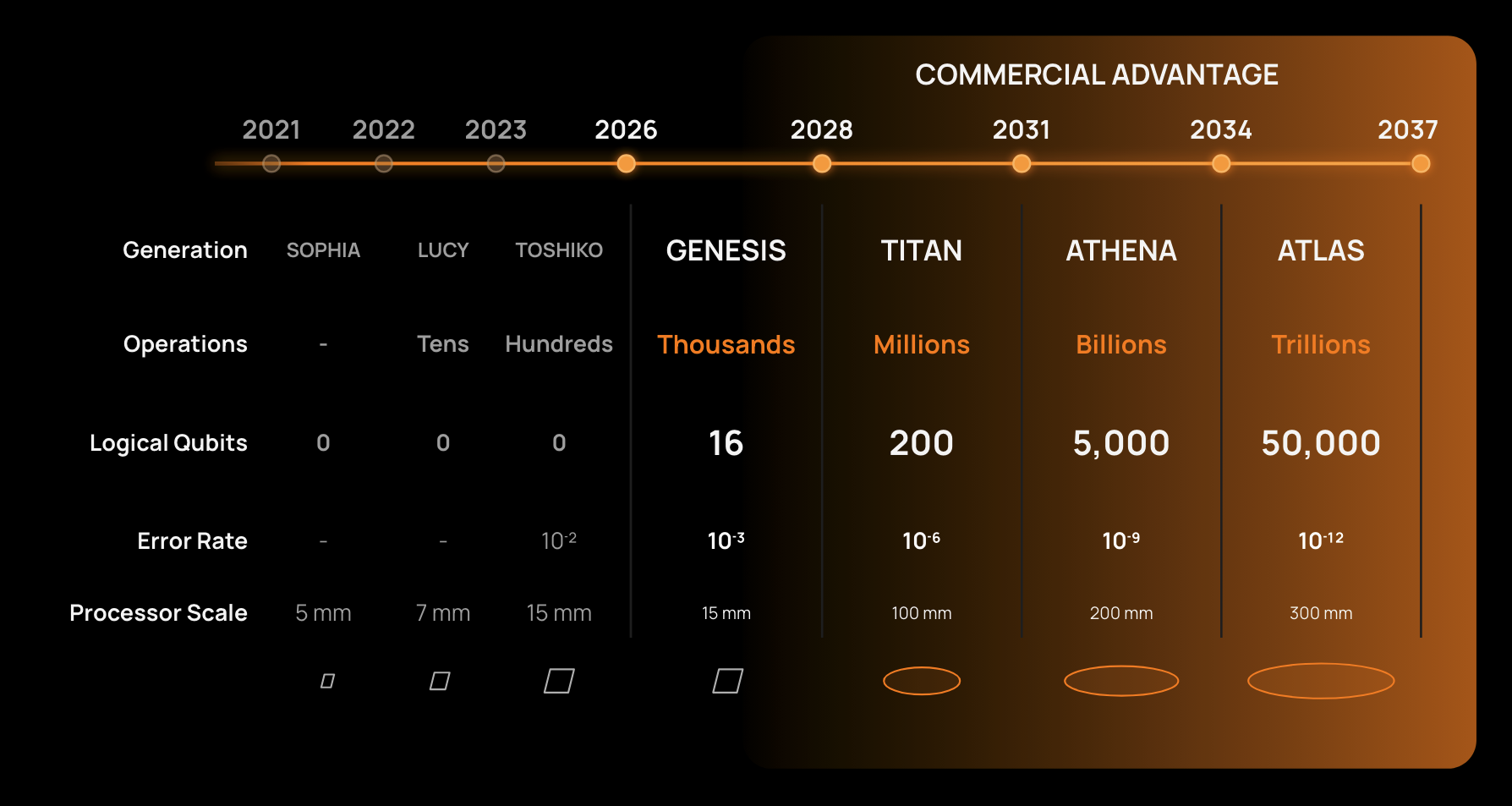
The KiloQuOp generation marks the start of OQC’s logical era, from 2026 to 2028. Utilising our patented OQC Dimon technology, with a single dual-rail-encoded logical qubit, to fit in the same footprint as a single Coaxmon qubit.
THE OQC ROADMAP
Fastest path to commercial advantage

OQC GENESIS
KiloQuOp Era
System scale to deliver KiloQuOp:
LOGICAL QUBITS:
16
LATTICE SITES:
16
LOGICAL ERROR RATE:
10-3
PROCESSOR SCALE:
15mm

PROCESSOR
The OQC GENESIS generation is an evolution of the Toshiko generation processor featuring OQC’s multi-mode Dual-rail Dimon Qubit (DDQ) technology to create logical qubits.We replace certain physical qubit lattice sites on the chip with DDQs, but keep the simple I/O, making this one of the most hardware efficient architectures for quantum error correction.
SYSTEM
An upgraded OQC Toshiko build featuring quantum error detection.


THREAT DETECTION
Quantum computers are able to better detect vulnerabilities within security networks enabling optimised risk simulation by using methods that train a family of parameterized unitary time-devolution operators to cluster normal time series instances.
CLASSIFICATION
Quantum computing offers novel approaches to enhance or accelerate classification, for example in complex or high-dimensional financial datasets. There is particular promise in adversarial classification, a scenario where we have a third party attempting to confuse the classifier by adding small deviations to the object being classified.
FRAUD DETECTION
Quantum computing can identify subtle anomalies in high-dimensional transaction data that classical systems might miss. By encoding transaction attributes into quantum states, these models can potentially generalise better on small and complex datasets.
VULNERABILITY ANALYSIS
Using quantum to identify, classify, and prioritise security weaknesses in a system, network, or application by identifying the paths to security compromise on a network.
ARBITRAGE
Quantum computing could allow for the identification and seizing of profitable opportunities before others and before price corrections. By using quantum algorithms for statistical arbitrage trading by utilising variable time condition number estimation and quantum linear regression.
OQC TITAN
MegaQuOp Era
This is the era for commercial advantage. To deliver MegaQuOp generation systems, OQC will scale its devices to achieve a 10-6 error rate, 200 logical qubits within 2,000 lattice sites, enabling millions of quantum operations. The clock speed, defined as the QuOp cycle rate, is expected to be 1 MHz. OQC TITAN will outperform classical compute for applications in financial services and in security & defence.
System scale to deliver MegaQuOp:
LOGICAL
QUBITS:
200
LATTICE
SITES:
2,000
CLOCK
SPEED:
1MHz
LOGICAL
ERROR RATE:
10-6
PROCESSOR
SCALE:
100mm

PROCESSOR
This 100 mm wafer-scale processor will feature 2000 lattice sites, all inclusive of OQC’s multi-mode qubits: offering minimal hardware overhead and inbuilt primary error correction. Further quantum error correction occurs with minimal redundancy – scaling to 200 logical qubits at very low error rates to run millions of quantum operations. This will include our wafer-level packaging that supports thousand-qubit scaling.
SYSTEM
The OQC TITAN generation devices will include quantum error correction code concatenation to reach millions of quantum operations, and enable near-term applications.
APPLICATIONS
This era of devices will enable customers to identify important events and anticipate what happens next
- Detect fraud
- Uncover new scam and cyber threat patterns
- Assess merchant risk and opportunities


CRYPTANALYSIS
Elliptic curve cryptography is a public-key cryptosystem used for key agreement and digital signatures, and is commonly relied on for cryptocurrencies. There is currently no known classical algorithm that can efficiently break this security guarantee. Shor’s algorithm, originally developed for problems such as integer factorisation (used in RSA) can also be applied to the group structure of elliptic curves, thereby breaking the security guarantees of elliptic curve cryptography.
MATERIALS SIMULATION
The simulation of materials is one of the most promising applications of quantum computers by determining the ground and excited state properties of materials. These computed values then serve as initial conditions for DFT run on a classical computer, improving convergence and quality of this large scale simulation.
DERIVATIVE PRICING
Quantum deep hedging could reduce risk for a portfolio by using quantum reinforcement learning models. Quantum deep hedging considers market frictions and trading constraints using methods based on policy-search and distributional actor-critic algorithms that use quantum neural network architectures with orthogonal and compound layers for the policy and value functions.
DEEP HEDGING
Quantum computing can quadratically speed up risk calculations by improving sampling efficiency, particularly when using Quantum Signal Processing (QSP) to encode financial derivative payoffs directly into quantum amplitudes, alleviating the quantum circuits from the burden of costly quantum arithmetic.
OQC ATHENA
GigaQuOp Era
This era will enable billions of operations, with devices scaling to 5,000 logical qubits, to begin to unlock quantum chemistry and materials simulation.
System scale to deliver GigaQuOp:
LOGICAL
QUBITS:
5,000
LATTICE
SITES:
75,000
CLOCK
SPEED:
3MHz
LOGICAL
ERROR RATE:
10-9
PROCESSOR
SCALE:
200mm

PROCESSOR
Our OQC ATHENA generation will release foundry-grade quantum processor units, fabricated on 200 mm wafers. This 200 mm wafer-scale QPU allows OQC’s patented extensible architecture to scale to 75,000 lattice sites. Each lattice site contains next-generation multimode qubits with enhanced primary error correction, retaining the same hardware requirements as individual qubits.
SYSTEM
A modular system optimisation supporting tens of thousands of lattice sites.
APPLICATIONS
This generation of devices will build on TITAN level applications and also enable customers to protect data and systems and accelerate their AI workflows:
- Protect data and compute
- Authenticate new suppliers
- Assure compliance as quantum capability is built
- Compress AI models
- Generate synthetic data
- Train and test models
- Develop new analytics

DECRYPTION
RSA 2048 is a public-key cryptosystem that is widely used for the encryption of data via the sharing of a public key and an unshared private key. It allows someone to encrypt a message with a public key that only the owner of the private key can decrypt. There is currently no known efficient decryption algorithm without the private key using a classical computer. Shor’s algorithm allows a quantum computer to efficiently decrypt these encrypted messages.
LINEAR ALGEBRA
The quantum singular value transform has many key application areas from solving systems of linear equations to Hamiltonian simulation. Solving systems of linear equations in particular can apply to computational fluid dynamics, machine learning and finite element analysis among many others. Hamiltonian simulation is a key tool towards quantum chemistry problems.
QUANTUM CHEMISTRY
The simulation of chemical systems using quantum computers leverages the ability of a quantum computer to simulate other quantum systems with great efficiency. Many problems in quantum chemistry are bound by the compute constraints of classical computers. It is natural for a quantum computer to encode and simulate another quantum system.
DRUG DISCOVERY
With its potential to minimise the expensive and time-consuming nature of facilitating end-to-end drug development, quantum computing could open new avenues for in-depth research on multifactorial diseases: necessitating the adjustments of multiple targets.
OQC ATLAS
TeraQuOp Era
This era represents a generational advancement, redefining industries and unlocking entirely new categories of economic value. Scaling to 50,000 logical qubits at a 10-12 error rate, the OQC ATLAS generation of devices will enable trillions of quantum operations.
System scale to deliver TeraQuOp:
LOGICAL
QUBITS:
50,000
LATTICE
SITES:
1,000,000
CLOCK
SPEED:
10MHz
LOGICAL
ERROR RATE:
10-12
PROCESSOR
SCALE:
300mm

PROCESSOR
The OQC ATLAS QPU is fabricated using 300 mm wafers and will scale to feature 1 million lattice sites with multi-layer connectivity. An advanced multi-mode qubit in each lattice site for primary error correction is paired with the ultimate in topological outer code efficiency, advancing to 50,000 logical qubits at very low 10-12 error rates.
SYSTEM
Generation defining devices, with advanced high-connectivity quantum error correction and tightly-integrated control, enabling fast and efficient fault-tolerant quantum computation.
APPLICATIONS
This generation will enable customers to also understand how systems could behave under certain conditions:
- Test payment network response to disruption
- Explore impact of changes in customer behaviour
- Model complex molecules for drug discovery

Built For Scale.
Delivered For Industry.
Every stage of our roadmap is engineered for practical deployment from physical qubit breakthroughs to orchestration, access, and infrastructure integration. Whether via cloud, colocation, or sovereign installations, OQC is delivering the world’s most accessible and commercially viable path to fault tolerance.
Our Vision
To deliver useful, scalable, and sovereign-ready quantum systems: accelerating the transition from today’s hybrid experimentation to tomorrow’s industrial-strength quantum workloads.
Stay Ahead
With OQC
Quantum advantage won’t wait – and neither will we. Our roadmap is accelerating. Join us at the frontier of performance, scale, and commercialisation.