TECHNICAL BLOG
OQC Research for 3D Integrated Embedded Filters for Superconducting Quantum Circuits
- Purcell filtering has become a widespread tool used to protect qubits from unwanted radiative relaxation through readout channels and to enable fast readout.
- We have successfully demonstrated a novel 3D-integrated superconducting qubit package with Purcell filters to counter the Purcell decay effect and enable read out multiplexing without increasing the physical footprint of our superconducting quantum processors.

Brian Vlastakis
VP OF QUANTUM SCIENCE & EXPLORATORY RESEARCH

Brian is VP of Quantum Science & Exploratory Research at OQC. Originally from the United States, Brian moved to the UK in 2017 where he has served as a Marie Curie research fellow at the University of Oxford focusing on superconducting quantum circuits. Previously a research staff scientist for IBM, Brian helped develop their large-scale quantum computing platform. He was also a part of the founding team for the ‘IBM Quantum Experience’, the first publicly-accessible quantum computer. Brian received his PhD in experimental physics at Yale University with work that showed the largest ‘Schrodinger cat states’ to date using microwave photons.
Superconducting qubits are placed among the leading modalities considered for quantum applications due to their advantages in speed, scalability and their versatility, which allows for fine-tuned control of the qubits. This modality is not without its challenges however, as superconducting qubits are sensitive to decoherence, due to energy relaxation and noise.
The successful preparation, manipulation and readout of quantum information is essential to quantum computation. Despite their enormous power derived from the interaction of different qubits, quantum states are very fragile and the process of qubits maintaining their quantum states from initialisation through to readout is very delicate. Therefore, a key challenge for superconducting qubit architectures is designing a scalable system that enables fast state readout, while maintaining high coherence.
The challenges in readout of quantum information
Readout is the process in which qubits are measured or their state determined after quantum computation has occurred. The states of qubits are read using resonators which are coupled to the qubit. During readout however, a mechanism, known as the Purcell effect, is encountered in which qubit excitations decay directly into the readout channels. This mechanism must be controlled in a scalable way for fault-tolerant quantum computing to be achieved. While there are multiple ways to manage the Purcell effect and improve Purcell protection, many of the existing readout techniques in superconducting circuits lengthen the qubit readout time introducing a compromise between measurement speed and qubit coherence.
Purcell filtering has become a widespread tool used to protect qubits from unwanted radiative relaxation through readout channels and to enable fast readout, thereby improving the trade-off imposed by the Purcell effect. While mitigating the Purcell effect to a high degree however, the footprint of the filters created are often larger than the qubit itself and lead to an increase in the size of the quantum processor. This in turn creates a new challenge to address with many current solutions requiring additional fabrication and packaging processes which often increase the complexity of the quantum processor manufacturing. Using and improving Purcell filters to extend the lifetime of superconducting qubits is therefore an ever-present challenge in scaling quantum computing platforms.

OQC’s latest research in Purcell filters
While most superconducting quantum processors interface with printed circuit board (PCB) packaging for signal delivery, to-date there has been no reported work using Purcell filters integrated into such packaging. In our latest preprint, released on arXiv, our Quantum Science & Exploratory Research team present the development of novel Purcell filters integrated within a multilayer printed circuit board for superconducting quantum circuits.
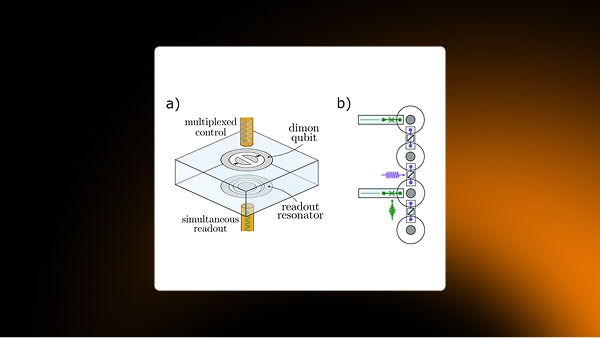
The integrated Purcell filter in the presented work is a means of countering the Purcell decay effect within qubits by limiting the photons that can decay through the resonator readout line. The proposed design achieves this by employing a novel method in which a bandpass filter is embedded within a multiplexing circuit using conventional PCB-based multilayer technology and an antenna-like design.
The design splits a superconducting quantum processor into layers; containing qubits, resonators, filters, control and readout (Figure.1). The PCB stack consists of 3 layers where the filter is the middle layer, taking the form of a triangular-shaped, coplanar patch antenna with an out-of-plane feedline. The shape is chosen to maximise the coverage of multiple qubits while maintaining symmetry for tiling, whilst its middle layer position protects any neighbouring filters from crosstalk.

Simulation and modelling
In the undertaken research, the design is simulated, manufactured and measured at cryogenic conditions with a 35-qubit chip. The filters are designed to have a wide bandpass response at the readout frequency of 10 GHz, and a 3 dB bandwidth of 0.88 GHz, meaning that any signals falling within this band are passed through the filter, while frequencies outside of this band are blocked. Through this process we enable frequency-multiplexed qubit state readout enabling support up to 9 readout channels.
Benefits to this novel approach
The results of this work carried out demonstrates that all qubits can be read using this PCB-based technology and shows a clear increase in the lifetime of the qubits. The off-chip design removes all filter components from the qubit substrate itself, enhancing device modularity and packaging reusability. With each filter able to couple to nine readout resonators simultaneously, multiplexed readout is also enabled.
The 3D design does not increase the physical footprint of the device, as it fits entirely within the footprint of the qubit layout itself. This enables a filter and signal layout which can be easily tileable and scalable for a larger number of qubit chips without increasing the complexity of the quantum processor manufacturing, a necessity as quantum computing scales towards fault-tolerant quantum compute.
Read the pre-print on arXiv: https://arxiv.org/abs/2602.24003
Join our newsletter for more articles like this
By clicking ‘sign up’ you’re confirming that you agree with our Terms & Conditions
YOU MAY ALSO BE INTERESTED IN
The latest key resources
The Rise of Superconducting Erasure Qubits – an Industry Perspective
Making Quantum Errors Visible: A New Approach to Reliable Quantum Computing
OQC Research for 3D Integrated Embedded Filters for Superconducting Quantum Circuits
Bringing Quantum to Real Payments: A New Approach to Fraud Detection

Securing the Future: How OQC and QinetiQ Are Advancing Quantum for Defence and Security, A New Frontier in Defence Technology