TECHNICAL BLOG
Making Quantum Errors Visible:
A New Approach to Reliable Quantum Computing
- New research from OQC helps make errors visible: OQC’s approach turns normally “silent” errors into detectable events (erasures), allowing faulty runs to be identified and discarded.
- By repeating only the runs where errors are detected, overall computation reliability can increase without heavy error-correction overhead.
- The OQC team has developed simulation tools to model erasure noise and postselection in quantum circuits. These tools allow researchers and customers to explore how error rates, circuit complexity, and detection performance influence the overall efficiency of a quantum computation.
- OQC has introduced erado: an open-source Qiskit-based library that simulates erasure noise and postselection, helping researchers explore when this approach is effective.

Sam Griffiths
SOFTWARE ENGINEER


Sam is a software engineer and scientific researcher at OQC. In our Innovation Transfer team, his work with us ranges from full-stack software and systems engineering, through to scientific research in quantum error correction and mitigation. Sam completed his PhD in computer science and physics at University College London under Prof. Dan Browne, co-sponsored by Riverlane. Specialising in scalable decoding for quantum error correction, his previously-published work includes optimising union–find decoders for surface codes, and extending similar approaches to LDPC codes with novel Gaussian elimination techniques.
Building useful quantum computers requires more than increasing qubit numbers. Reliability (the ability to run increasingly complex quantum circuits without errors overwhelming the computation) is one of the defining challenges for the field.
In our latest pre-print, the OQC team explores an approach that could make certain quantum errors easier to manage by making them visible when they occur. Rather than allowing errors to silently corrupt a calculation, this approach enables the system to detect when a qubit has left its valid computational state. When that happens, the affected run can simply be discarded and repeated.
This strategy, known as erasure detection and postselection, offers a promising route to improving the reliability of quantum computations on near-term hardware. The work, called erado, is OQC’s open-source Qiskit-based Python library for the simulation of circuit-level erasure noise and postselection, with arbitrary quantum circuits.
The challenge of invisible errors
Quantum computers are inherently sensitive systems. Interactions with the surrounding environment can introduce errors that disrupt calculations long before they finish.
Most of these errors occur ‘silently’. A qubit may lose energy or drift away from its intended quantum state without any indication that something has gone wrong. Because the error location is unknown, complex error-correction techniques are required to identify and repair the damage.
These techniques are powerful, but they come with significant overhead in both hardware and computational resources. For quantum computing to scale efficiently, reducing this overhead is essential.
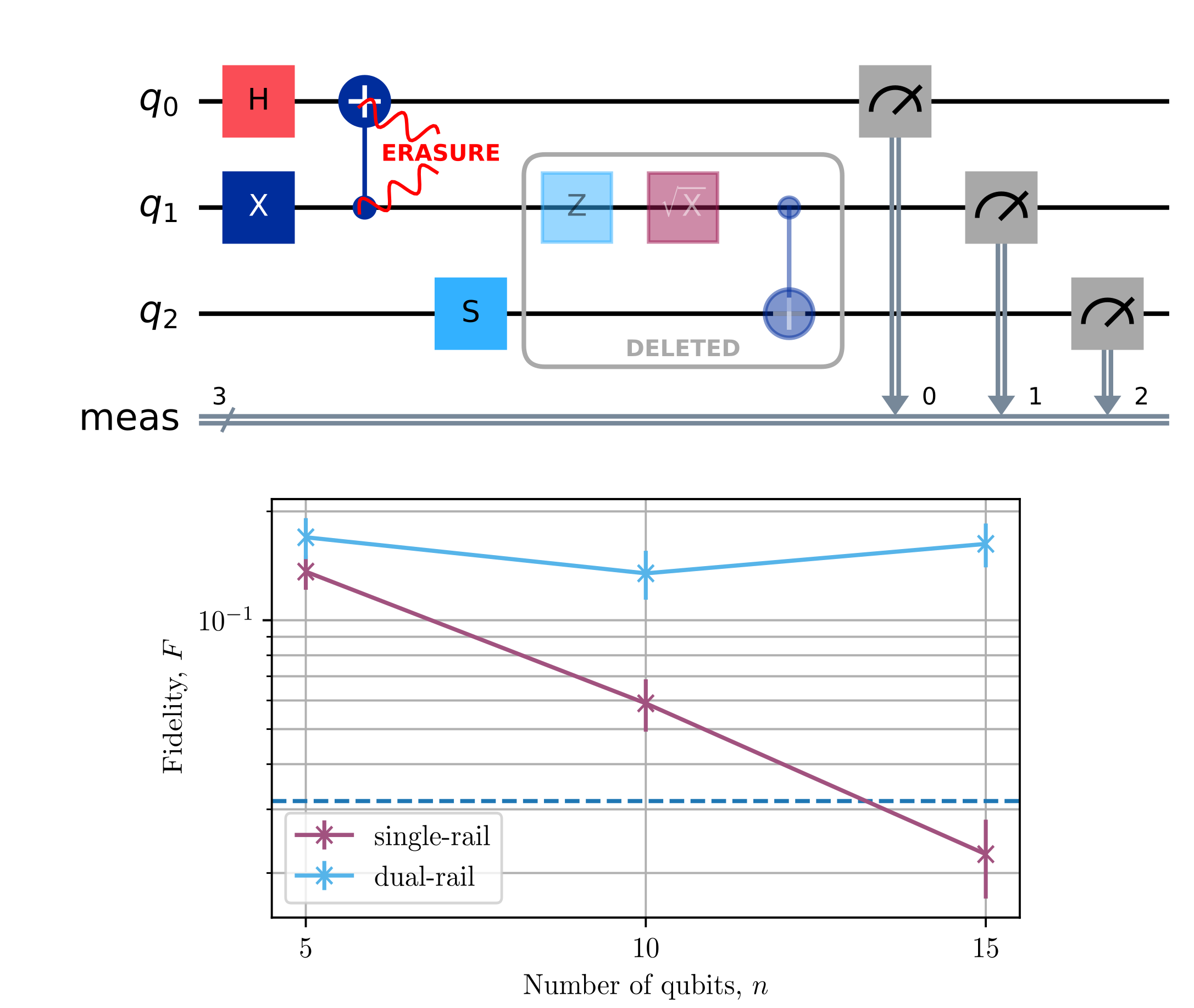
An alternative approach is to design qubits so that the most common type of error is a detectable, or ‘heralded’, event known as an erasure. In an erasure error, the system doesn’t just subtly drift from its intended state, but leaves the computational space entirely in a way that can be explicitly observed. When this happens, the system effectively raises a flag saying that this result cannot be trusted.
This information is extremely valuable. If an erasure can be reliably detected, the system can simply discard that run of the computation and repeat it, rather than trying to infer and correct the mistake afterwards. This technique is called postselection.
For certain types of quantum hardware, including architectures based on dual-rail qubit encodings, this type of error detection can emerge naturally from the physics of the system.
Turning errors into detectable events
One way to reduce the burden of error correction is to change the way quantum information is encoded.
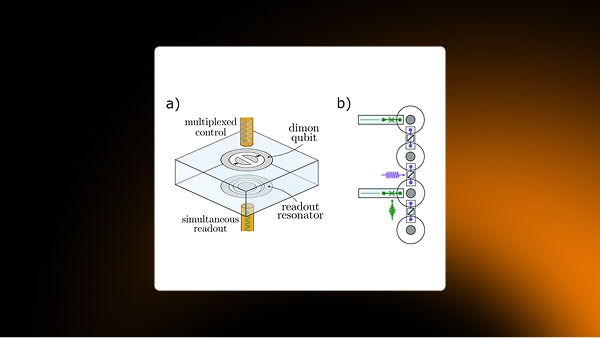
In our work, we explore qubits encoded across two physical modes, sometimes referred to as dual-rail qubits. Instead of storing information in a single component, the quantum state is distributed across two.
This structure introduces an important advantage. If one of the physical elements loses energy, one of the most common types of error in superconducting quantum hardware, the system can transition into a state outside the valid computational space. Crucially, this transition can be detected via a measurement which doesn’t otherwise affect the logical state.
When this happens, the system effectively raises a flag indicating that the computation has been compromised and , rather than allowing the error to propagate through the rest of the circuit, the affected run can be discarded and repeated.
Measuring the benefits
Detecting errors in this way can significantly improve the reliability of quantum computations. However, it also introduces a trade-off. Every discarded run means the computation must be repeated. If errors occur too frequently, repeatedly restarting the circuit can quickly become costly.
To understand when this approach is beneficial, the OQC team has developed simulation tools to model erasure noise and postselection in quantum circuits. These tools allow researchers and customers to explore how error rates, circuit complexity, and detection performance influence the overall efficiency of a quantum computation.
As part of this work, we have released an open-source simulation library, erado, built on top of Qiskit. This enables researchers to model erasure-aware noise and investigate how postselection strategies impact different quantum algorithms.
The results show that erasure detection could improve the reliability of quantum computations under certain conditions: particularly when the dominant errors are detectable and when detection itself is highly reliable. However, the benefits are not unlimited. If detection is imperfect or if the rate of erasure events becomes too high, the cost of repeated postselection can grow rapidly.
Understanding these limits is essential for guiding the design of next-generation quantum hardware and algorithms. In other words, the value of erasure-aware architectures lies not only in the concept itself, but in knowing when and where they provide the greatest advantage.
Designing the next generation of quantum systems
The results of this study highlight both the promise and the limitations of erasure-based approaches. When error detection is reliable and the rate of erasure events remains manageable, postselection can significantly improve the quality of quantum results. But the benefits depend strongly on hardware design and system performance.
Understanding these trade-offs is critical for guiding the development of future quantum architectures. Research like this helps inform how quantum hardware, qubit encodings, and error-mitigation techniques can work together to deliver more reliable computation.
Advancing practical quantum computing
At OQC, our mission is to build scalable quantum computing systems that deliver real-world value. This requires tackling the practical challenges of operating quantum processors, including how errors arise, how they propagate through circuits, and how they can be detected or mitigated.
By exploring new approaches such as erasure-aware qubit encodings and postselection, at OQC we are developing a deeper understanding of how quantum systems can be made more reliable and more useful. As quantum hardware continues to advance, insights like these will help shape the architectures and techniques that underpin the next generation of quantum computers.
For a conceptual introduction, usage instructions and API reference, and more information:
REPO: https://github.com/oqc-community/erado
DOCS: https://oqc-community.github.io/erado
PYPI: https://pypi.org/project/erado
Join our newsletter for more articles like this
By clicking ‘sign up’ you’re confirming that you agree with our Terms & Conditions
YOU MAY ALSO BE INTERESTED IN
The latest key resources

The Rise of Superconducting Erasure Qubits – an Industry Perspective
Making Quantum Errors Visible: A New Approach to Reliable Quantum Computing
OQC Research for 3D Integrated Embedded Filters for Superconducting Quantum Circuits
Bringing Quantum to Real Payments: A New Approach to Fraud Detection

Securing the Future: How OQC and QinetiQ Are Advancing Quantum for Defence and Security, A New Frontier in Defence Technology